
How to Check Motorcycle Part Compatibility Before You Buy
Last Updated: November 20, 2026
Quick Summary
To check motorcycle part compatibility, first gather your bike's exact year, make, model, trim, and VIN, then match the part's OEM number against the manufacturer's parts catalog for your specific bike. Confirm the listing's year range, trim, and mounting dimensions before you order.
- Write down year, make, model, trim, VIN, and engine details before you start shopping.
- Find the OEM part number on the old part or in the manufacturer's parts fiche.
- Check for superseded part numbers, since manufacturers sometimes replace older numbers.
- Confirm your exact model year falls within the listing's fitment range.
- Measure mounting points and connectors on high-risk parts like brakes and suspension.
Is this part right for my bike?NE Cycle Shop lists fitment details and part numbers so you can order with confidence.
Check Part Fitment Now
Table of Contents
- Gather Your Bike's Identifying Details First
- Cross-Check Using a Parts Interchange Chart
- Choosing Between OEM and Aftermarket Parts for Your Bike
- Placing Your Order With Confidence at NE Cycle Shop
- Frequently Asked Questions
Gather Your Bike's Identifying Details First
Buying a part that doesn't fit wastes money and time, and checking motorcycle part compatibility early prevents most returns.
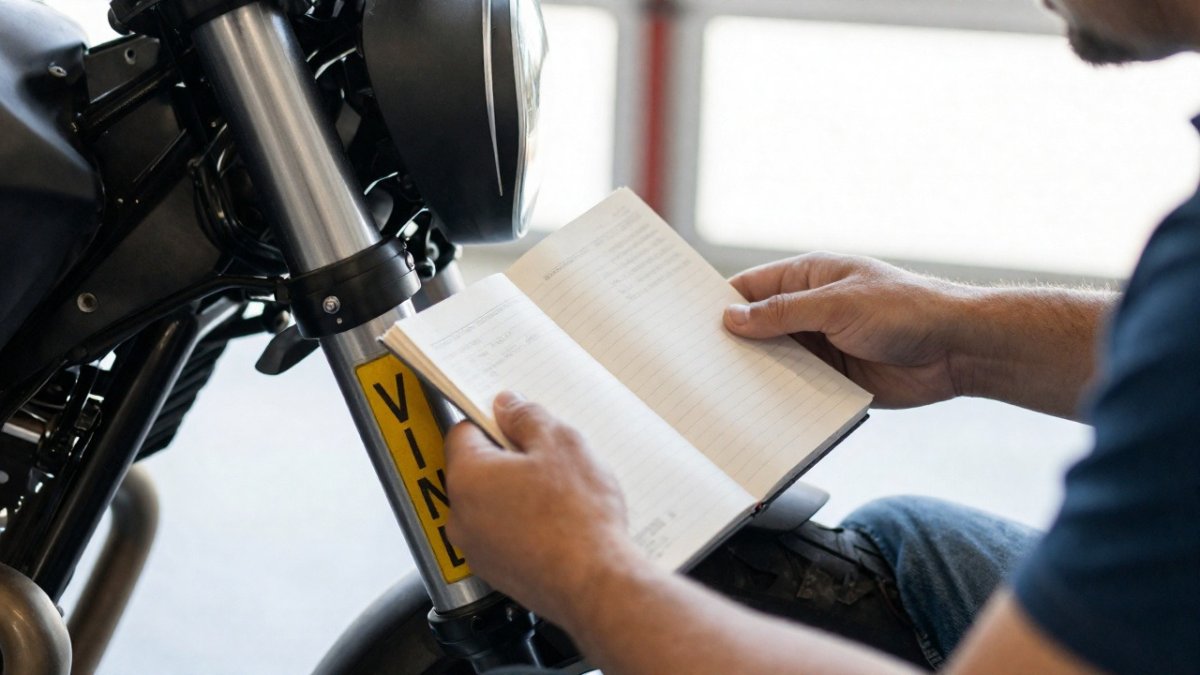
Before you order, check these common fitment points against your bike.
| Check | What to confirm | Why it matters |
|---|---|---|
| Model name | Exact model, not just the brand | Listings can cover several models |
| Year range | Your model year falls in the listed range | Parts change mid-generation |
| Trim or market | Matches your trim and region | Same model name can use different parts |
| Dimensions | Mounting points and lengths match | "Universal" parts do not always fit |
| Connectors | Plugs and pin counts match | A part can plug in and still be wrong |
Cross-Check Using a Parts Interchange Chart
A parts interchange chart shows which components from different models or years share the same design. These charts help when a specific part is discontinued or hard to find.
Use an interchange chart as a second check, not the only one.
How to use an interchange chart well:
- Match the OEM number first, then use the chart for alternatives
- Confirm the alternative's fitment on the seller's listing
- Check that dimensions, mounting points, and connectors match your bike
Common mistake: assuming two parts with the same name are interchangeable. Always verify the part number and fitment notes.
Choosing Between OEM and Aftermarket Parts for Your Bike
OEM parts are made to the manufacturer's original specifications. Aftermarket parts come from other manufacturers. Neither is automatically better, the right answer depends on the component, how you ride, and how much verification evidence the seller provides.
The more useful question is not "OEM or aftermarket?" but "what kind of part is this, and how much does a fitment error cost me?" Compatibility risk is not uniform across a motorcycle.
Compatibility Risk by Component Type
Brakes (calipers, pads, rotors, master cylinders, lines). Treat these as the highest-risk category.
Electrical (stators, regulators, CDI/ECU, harnesses, sensors). Connector shape, pin count, wire color, and voltage output matter as much as mounting.
Bodywork and controls (fairings, fenders, levers, pegs). Mounting tab locations and lever pivot geometry are the usual failure points.
Consumables (filters, chains, sprockets, tires, fluids). Fitment is usually straightforward, but pitch, width, and load rating still matter.
Assessing Used and Modified Parts
Used and modified parts are where catalog fitment tools stop helping, because the catalog describes the part as manufactured, not as it sits in the seller's hands.
- Wear. Ask for measurements, not just photos: brake rotor thickness, bore diameter, bearing play, and tread depth. A part within its service limit is usable; one below it is not, regardless of fit.
- Prior modifications. Ported heads, drilled airboxes, cut fenders, and re-welded mounts change fit and function. Ask directly whether the part has been modified and request photos of the modification.
- Missing hardware. Brackets, spacers, bolts, and clips are often sold separately. Confirm what is included, because a part that fits but lacks its mounting hardware may not install.
Watch out: a used part from a different model year carries higher fitment risk even when the model name matches, so verify its dimensions against your bike before installing.
A Decision Process for Conflicting Information
Fitment information conflicts more often than buyers expect, a catalog says one thing, the seller another, and the part looks close but not exact. Work through it in this order:
- Trust the OEM number for your exact bike first. If the manufacturer catalog lists the number for your year, model, and trim, that is the strongest single signal.
- Check the supersession chain. If the numbers differ, confirm whether one supersedes the other before calling it a mismatch.
- Measure the physical interface. Mounting bolt spacing, bore diameter, shaft diameter, and connector pin count are decisive when documents conflict.
- Weigh the component's risk. For brakes, suspension, and steering, resolve every conflict before installing. For cosmetic parts, a small dimensional difference may be acceptable.
- Document the result. Record the OEM number, the measurements, and the source you relied on, so a return or a future order is easy to justify.
If a conflict remains, contact the seller or a dealer with the OEM number and your VIN before buying. A few minutes of confirmation costs far less than a return, or a failed install.
Placing Your Order With Confidence at NE Cycle Shop
Once you have verified the part number, fitment, and dimensions, you are ready to order. Before you check out, run through this checklist:
- Year, make, model, and trim match the listing
- VIN or OEM number matches or is listed as a valid cross-reference
- Mounting points and dimensions match your existing part
Orders placed at NE Cycle Shop by 3PM Eastern Time ship the same day, Monday through Friday. Delivery time after that depends on the carrier and your location, so plan for transit time if you need the part for a weekend ride.
Ready to order? Check your bike's details against the listing, then head to checkout. Browse our Kawasaki and Yamaha parts to find a fitment-verified replacement for your next repair.
Frequently Asked Questions
How do I find the OEM part number for my motorcycle?
Start with the parts diagram in your service manual or the manufacturer's online parts catalog, using your VIN and model year to narrow the listing. Each component on the diagram has a reference number, and that number is the OEM part number. Match it against the number printed on the old part if you can read it. Keep in mind that OEM numbers can be superseded when the manufacturer updates a part, so check whether the number you find has a newer replacement before ordering.
Can I use a part from a different year or model motorcycle?
Sometimes, but only when the part is listed as interchangeable for your specific year, make, and model. Manufacturers often change dimensions, mounting points, or electrical connectors between model years even within the same family. A part that looks identical can have a different bolt pattern or connector plug. Use a parts interchange chart to confirm, and never assume a close match is safe for safety-critical components like brakes or steering.
Are aftermarket motorcycle parts compatible with OEM parts?
Many aftermarket parts are designed as direct replacements for OEM components, but compatibility depends on the specific part and listing. Check whether the aftermarket listing states the OEM number it replaces and confirm the dimensions, mounting points, and connector type against your original part. Parts that are not listed for your exact model year may still fit, but verify before installation. Keep the original part until the replacement is confirmed to fit.
What should I check before buying a used motorcycle part?
Confirm the donor bike's year, make, model, and trim so you know exactly what the part came from. Inspect for cracks, wear, corrosion, and bent mounting points, since used safety-critical components such as brake parts and steering components can hide fatigue damage. Compare the part's OEM number to the number on your bike's parts diagram. If the seller cannot identify the source or the part number, treat the purchase as higher risk.
